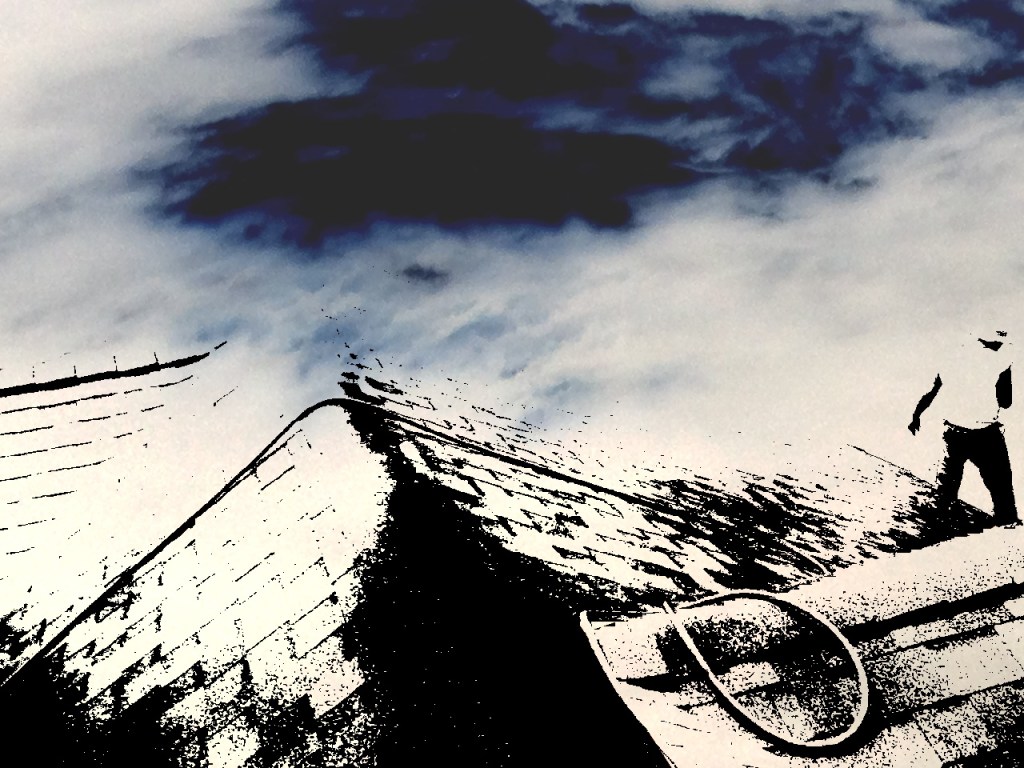
“He was plunged so deep in tunnel vision now that he was deaf to the thunder rolling off the rooftops around us.”
First Published 2015 in The South Carolina Review
Came like an act of God—that’s how my father described the storm, like it was a biblical event. He ducked through the back door, hedge trimmers still in hand, calling for my mom and me. Mom was already turning from the sink—the loud patter of hail on the roof was hard to miss. She dried her hands with a dish rag while Dad peeled off his shirt. It was soaked through and sticking to his skin, and I tried not to see the hairy white flesh of his belly when he turned to me. “What do you think? Pretty neat, huh?”
I set my controller on the arm of the couch. “It’s just a storm.”
Really, though, the storm was pretty interesting. The ice pellets were bouncing off the deck like golf balls, popping two feet up into the air after they hit, and the three of us just stood there in the living room together, a little way’s back from the sliding glass door, and we watched the storm pass. Every time a chunk of ice thunked against the skylight our golden retriever Penny would run a circle up onto the couch and then back down onto the rug. She yelped and barked until Mom took her by the collar and cooed in her ear.
The hail fell for ten minutes, and then the storm quit just as suddenly as it had started. A few last bits of ice trickled down. Then the sun pulled back from the clouds. I opened the door.
The storm had chilled the air, but that didn’t stop the dog from hurrying ahead to snap up the pearls of ice that had collected at the mouths of the downspouts. Our yard had become a collision of seasons: It was almost like winter because the ground was covered in ice, and it was almost like fall because the yard was scattered with leaves, but it was actually late May and everything was green.
I shuffled barefoot through the grass, felt the ice between my toes. Mom said, “Clay, don’t you think you should put some shoes on?” but I ignored her. In some spots the ice came up to my ankles.
Dad was all business, but underneath he was as awed as the rest of us. He circled the house twice, ogling the damage the storm had wrought: the pockmarks on the shingles, the cracks in the shutters, the dents on the vehicles. He stooped at the basement windows to examine each pane. He couldn’t remember the last time there’d been a storm like this. This was Pennsylvania, not Kansas. That’s what he kept saying, “This is Pennsylvania, not Kansas,” as if our true location had just dawned on him. He kept looking up at the holes of sky the storm had punched through the oak trees, shaking his head like something mystical had just happened.
The whole south side of Chambersburg had been hit, and it couldn’t have been hit at a better time for my father, what with the gloominess of the economy and the me-applying-for-colleges thing coming up in the fall. Back then it never occurred to me to worry about money, although I knew my parents often did, in hushed tones as If I didn’t understand what they were talking about. I guess then I didn’t. We had two vehicles in the driveway and snacks in the cupboards, and there was always enough money to replace my drumsticks and drumheads when I broke them.
I wasn’t concerned about our finances, and for once neither was Dad. In the weeks following the storm calls started coming in from our neighbors and our neighbors’ neighbors about new roofs, new siding, new shutters, etc. All it took was a call to their insurance companies and the job was paid for. Well paid for. As far as my father was concerned, the sky might as well have poured out silver dollars, or pearls, or mana from Heaven. That’s what he said, “Like silver dollars,” like it was 1955 and not 2008. He was almost giddy about it. The way he saw it, with the big banks failing and the government raising taxes, this storm was nothing less than a miracle.
He was certain of that, but I knew better. The storm was a freak thing, a random coincidence, as meaningless as high school and all the toil Dad would put me through come summertime. Tomorrow the weather would probably decimate a third-world country. I was confident of that.
♦
School wasn’t out two days before Dad put me to work. At 6:30 am he walked into my room and flipped on the lights. He grinned down at my twisted limbs. “Are we going to be a productive member of society today?”
I moaned angrily as I pulled the sheets over my head. I knew we were supposed to leave at 7:30—my alarm was set for 7:00—but there was Dad, pulling back the curtains and dribbling sunshine all over the bed.
“We’re rolling at 7:30,” he said, and he took a gulp of coffee from his oversized Looney Tunes mug. Probably his second cup. Most mornings he was awake and in the workshop by six.
I jammed a pillow over my face so he wouldn’t hear which curse word I was saying. He sensed it though and sieved air through his teeth, and I knew I’d knocked a little chunk off his stupid rise-and-shine routine. As he walked out he bumped the drum set, and when the cymbals stopped ringing I could hear an overtone rising off the snare and whining in the sunlight.
At 7:20 I forced myself out of bed and trudged to the bathroom. Without turning on the lights I brushed my teeth and tugged off my clothes. Stepping into the shower felt like re-entering a dream—except halfway through Dad popped the lock on the bathroom door. He stuck his head in and held up a pair of boots. “I need you to try on these roofing boots when you get out. One of the claims adjusters I talked to swears by ’em. He says they’ll make you stick like a billy goat.”
“Oh my fricking god, Dad, get out!”
“I’ll leave ’em outside the door.”
After that I let my shower run deliberately long. I wanted to punish my father for waking me up earlier than necessary. After I finished shaving I looked at the shoes lying outside the bathroom door: “Cougar Paws,” size elevens, “for the man who likes to be on top.” They looked just like regular work boots, except with soft rubber soles that were apparently designed for gripping the slanted surface of a roof. Like a billy goat.
I pulled on the boots, walked down the hall, and decided they were too big.
♦
The house was a brown-brick ranchers with a seven-twelve pitch. That means for every twelve inches out, the roof rises seven inches. Dad explained the whole thing on the short drive over. “It’s a pretty steep pitch, but that’s all right because the insurance company will pay us more. The only thing is, you have to remember to double-nail the shingles in the middle. Anything more than a five-twelve pitch you have to double-nail.”
I grunted. He continued.
“The roof measures twelve-square, so this’ll be a three-day job. Two days to replace the shingles and one more to hang the new gutter. We’re not gonna dick around on this one.”
Orchard Drive, once it crosses the railroad tracks and shoots up into town, is a long hill lined with cookie-cutter townhouses and small apartment complexes. The house at the top of the hill, the one on the corner of Orchard Stanley, had five guys on it prying up shingles with flat black spades. Dad turned the corner without commenting on how they already had their roof half stripped, but I was sure he’d noticed. He always noticed things like that.
When Dad backed the trailer into the driveway the homeowner, a thick-bearded old man named Mr. Beesecker, was standing on the roof waving to us. “Now, Mick,” he called down from the ladder, “I don’t want nothing on my roof you wouldn’t have on yours, you hear me? Only the best.” He was wearing suspenders but no shirt, fat plastic glasses, and a trucker hat with a fish on it. He was slightly deaf and overly zealous, and I hated him immediately.
When he finished coming down the ladder, he laid his hand heavily on my father’s shoulder. “Now I think I saw some water damage over by the chimney,” he said, and I decided he was an idiot. You can’t see water damage until the shingles are pulled off, but the old man just knew—he just knew—there was water damage. He knew because he knew everything, and he wasn’t shy. Mr. Beesecker talked while we unloaded our hail-dented trailer. Mr. Beesecker talked while we spread protective tarps over his prize-winning hydrangeas. Mr. Beesecker talked while we pieced together the scaffoldings. Mr. Beesecker never shut up.
When he saw the boots on my feet, he shook his head.
“Aw, now you don’t wanna be wearing a new pair of boots on a roof! You need shoes that are broken in, otherwise you are gonna get blisters.”
Thanks for making me aware of something I can’t do anything about, I thought. And it was true: the boots had been slipping up and down on my heels all morning. Dad could be so stupid sometimes.
“It’s okay, he’s tough,” Dad said as he heaved a stack of two-by-sixes up on top of the scaffolding.
“Well he’d better be,” said Mr. Beesecker. “It’s gonna be hotter than blazes up there this afternoon. And it’s near nine o’clock already. I never heard of roofers to work bankers’ hours.”
“We’re easing into the summer,” Dad said, sliding his eyes over at me. I turned away and jerked the old wooden ladder out of the truck bed. Mr. Beesecker began to talk about “craftsmanship.”
The day got better once we—that is, Dad and I—got on the backside of the roof. Dad had insisted that Mr. Beesecker, who had to be at least 70 years old, work as “ground crew,” so he wouldn’t fall off the roof and die. “I need you to throw all the dead shingles into the back of the truck, all right?” he said in a voice that made cleanup sound like an integral part of the roofing process.
Once we were on the roof, it was demolition. I liked demolition. It required no patience, no instruction from people who think they’re better than you, and no restraint. I liked the weight of the shingle shovel in my hands. You just throw your whole self into it until a rhythm emerges and you disappear completely. Ram the flat spade up under the shingles and pry back. Fling the dead shingles down to the ground where the old man, so small from way up here, bends to pick them up off the tarps before carting them around to the truck. Strip it down to the tar paper. Strip it down to the sheeting. Strip it down bare.
♦
We took a break just after the sun rose above the trees. The old man and I shared the shade of the little sugar maple in his backyard while Dad went around the front of the house to grab the cooler from the truck. “I’ll bet you’re glad you’re off to college soon. Am I right?” said Mr. Beesecker. “This work is pretty hard.”
I gave him a natural grunt. In my own mind senior year was the end of the world. I couldn’t picture what would come after or what I would do with my life. I kept a blind spot patched overtop of graduation and I went on living my life.
“We’re making good time, gentlemen,” Dad said as he came around the corner with the drinks. His knees popped as he sank down to the grass, but he was smiling. From the tone of his voice I half-expected him to start passing out cigars, but he only popped open the cooler. “I think I wanna get this back half covered completely today, shingles and all, and then we’ll tackle the front tomorrow.”
“Oh, now wait.” Mr. Beesecker held up his hand. “I’m going to my cabin tomorrow to pour cement. That won’t work for me.”
Dad feigned disappointment. “Well, I guess we’ll have to tough it out. You just make sure you’re back here for when we put the gutter up. We’ll need an extra set of hands then for sure.”
He tossed Mr. Beesecker a bottle of yellow Gatorade. The old man caught the drink and instantly began shaking his head. “Aw, now Mick, I’ll do you one better. I’ll go on in the house and make you up some lemonade.”
“Nah, this is fine,” Dad said as he pulled out another Gatorade for himself. “It’s better for you. It’s got electrolytes and stuff.” That, and Mom always inventoried the cooler when we came home to make sure Dad and I were “getting enough fluids.”
Mr. Beesecker undid the cap to his bottle and sniffed at the fluorescent liquid while I retrieved a can of Pepsi out of the bottom of the cooler. I was supposed to save it for the end of the day, as like a reward, but Mom would never know the difference. The old man took a timid sip of his Gatorade and winced. “Tastes like the stuff they make me drink before my colonoscopies.”
I cracked open my soda, and the sound made Beesecker’s head swivel.
“What are you drinkin’ Pepsi for? Don’t you know you’ll be thirstier ten minutes from now than you were before you drank the stuff?”
I am not a fricking child.
I looked up and saw Mr. Beesecker frowning at me. A block away the recess bell rang at Coldbrook Elementary where the migrant workers’ kids were in school for the summer. I hadn’t meant to say anything out loud except for maybe a grunt. I wasn’t sure I actually had said anything except for that look on Mr. Beesecker’s face. He was feeling the pleasure of feeling offended.
“I’m sorry, son, you’ll have to speak up. I don’t think I quite caught that.”
“He said he’ll be fine,” my father said as he leveled his gaze at me. “Why don’t you start carrying bundles off the skid and over to the ladder so I can take them up.”
Whatever, I thought, but I didn’t say a word. I stood up and walked around to the front of the house where there were forty-eight bundles of shingles sitting in a stack. They were there because the shingle truck—the one with the long conveyor belt that could’ve deposited the shingles directly onto the roof—had come and gone while I was in the shower punishing my father. Mr. Beesecker had told the driver to just leave the shingles by the mailbox. Yes, he was sure that would be all right with the contractor.
Each bundle was an 80 pound block of twenty shingles wrapped in pink plastic, about three feet long by a foot-and-a-half wide by a half-foot thick, and they were heavier than anything I’d lifted since I’d carried the tympanis up the steps outside the band room when we were setting up for the spring concert in the auditorium. But it wasn’t just that the bundles were heavy. Whenever you pick them up with a hand on each side the shingles sag like a fish and the weight of the bundle shifts away from your hands toward the middle. The bundles were so hard to hold—and so heavy—that my breathing tightened into a growl whenever I took them into my arms and waddled up the driveway. They did, however, make a satisfying smack when the hit the pavement beside the ladder.
After I’d lugged my third bundle over to the ladder, Dad came around the corner of the garage and tossed his empty Gatorade bottle into the bed of the pick-up. He watched me struggle with bundle number four, and then he started shaking his head. “No, no, no,” he said, stepping in and taking the bundle right out of my hands. “You want to carry ’em on their sides, like this, so they don’t droop on you.” He flipped the bundle onto its side and held it up for me.
“I knew that.”
He shrugged. “Just trying to make your life easier.” Then he bent his knees and heaved the bundle onto his shoulder before starting up the ladder. “Need twenty more.”
“I know.”
Mr. Beesecker came around the corner. I walked away before he could tell me the same thing.
♦
The air nailer gave a series of pneumatic snaps as Dad jabbed it against the shingles I’d just slid into place. His final punch left an empty circular imprint in the black grit of the shingle. “Shit, I’m out.” He looked up at me. I was squatting above him, feeding shingles down from the bundles draped over the peak of the roof. “Toss me some bullets.”
I stood up and walked over to the cardboard box and threw Dad another coil of nails. Then I pulled a utility knife from my pocket, slit open another bundle, and carried a half-dozen shingles back to where Dad was working. While he pulled the rubber band off the coil and nested the nails into the gun, I peeled two shingles apart—they come in back-to-back pairs—and slid them into place so he could line them up and tack them down.
I wiped my face against my shirt sleeve, rubbing the stinging sweat from my eyes without touching my gritty hands to the sun-burnt skin around my eyes. We were three-quarters up the roof, and all I could think about was putting on a Radiohead album and falling into bed. My shoulders were sore from prying up shingles and my lower back was sore from lugging bundles to the ladder and my knees were sore from carrying heavy rolls of ice-and-water shield out into the grass where I’d knelt and cut them into twelve-foot strips of tar that Dad stuck down to the bare yellow plywood sheeting. There were even dull aches forming in my arms and legs and, especially, in my ankles (fricking shoes) and sweat was stinging the patch of skin I’d shaved that morning.
To pass the time I was counting up the hours I’d worked so far—one, two, three, four, five, five and a half—and then trying to guess what number I should multiply them by—seven dollars? eight? ten?—to figure out how much money I’d make today. Maybe ten. Dad had mentioned something about making more because of the steep pitch.
Meanwhile Dad was in his glory, his shirt draped over the chimney, his bare skin shiny with sweat, his breath rhythmic like a tribal dance. It was embarrassing, his jelly gut up there two stories in the air for everybody to see, and my t-shirt was soaked through at the armpits. I just wanted to be home.
But I knew there was no way my father would release me before the back side was finished. Until then it was the lifting, carrying, peeling, and placing of shingles, followed by the metallic chunk of the air nailer like a metronome losing time.
♦
When we’d papered the roof with shingles all the way to the crown, it was 3:30. “Let’s pack it in,” Dad said as he scanned our day’s work. He handed me the air nailer. “Here, Clay, take this down and then start wrapping up the cords. I’ll be down in a second.”
I walked across the roof, climbed halfway down the ladder, and jumped to the ground. Mr. Beesecker looked up from the wheelbarrow. “Now you be careful jumping like that. You’ll bruise your kidneys, get kidney cancer.”
The air nailer gave a sharp hiss as I disconnected it from the supply line, and I let that sound stand in as my response.
After I coiled the hose, I started wrapping up the extension cord just the way Dad likes it, first plugging the cord into itself and then bringing in double loops of orange until there was just enough slack to wrap around the middle, pinching the cord into a bowtie shape. Wrapping it this way made it easier to unravel next time. That’s what Dad would say anytime I tried to do it any other way.
When the tools were put away and Mr. Beesecker had finally stopped talking and gone inside, Dad tossed me the keys. “You’re driving home.”
“I don’t know how to pull the trailer.”
“You don’t have to. We’re leaving it here.” He climbed into the passenger seat, so I walked around the cab and started the engine. But I wasn’t fast enough—Mr. Beesecker emerged from the house with his hand in the air like he was hailing a taxi.
“Now Mick,” he said, leaning his whole head through my window, “are you sure you can manage around here without me?”
“We’ll do the best we can. How do you think it looks so far?”
I shut my eyes. That was a loaded question.
“Well, it’s not bad I guess per se, but I am concerned about the water damage by the chimney.” He pulled his head out of the window and pointed at the chimney, as if we might not have noticed it up there. “It’s always given me trouble, and I’ve had outfits out here before, you see, and—”
“We’ll tackle it when we get to it, Mr. Beesecker. Don’t you worry. I’ll be seeing you.”
Dad gave a little nod, and I put the truck in drive. Mr. Beesecker called after us, “Well, all right, you boys rest up now!”
“Turn left up ahead and then left again,” Dad said. When we were on the street that ran behind Mr. Beesecker’s house, Dad leaned over to see out my window. “Stop here, just for a second,” he said. “You gotta stop and look at your handiwork.”
I looked out the window. It was a bunch of shingles on a roof. I looked in the rearview mirror. “Dad, there’s a car behind us.”
“All right.” He flipped down the driver’s side visor where he always had a few dollars stashed. “Drive us over to the Big Oak. We’ll get some sweet tea.”
I gave a noncommittal grunt. Dad began to unlace his boots. “Your pap used to say you figure the price of a job, and then, if the homeowner wants to help, you charge him double.” He tossed his boots over his shoulder, one after the other, and I didn’t know what to say. This was the first he’d mentioned my grandfather since the funeral back in February. He started strapping on his sandals. “I know Beesecker’s a pain in the ass. Thanks for putting up with him. You did a good job today.”
He was my dad. He had to say that.
He went on, “I am gonna need you earlier tomorrow, though. They’re calling for weather in the afternoon, but I would love to get the rest of the roof done while he’s gone, and I think, with both of us, we can pull it off. At the very least we oughta be able to get all the ice-and-water shield down before the storm hits. You think you can be ready by seven?”
I pulled the truck into the parking lot, and Dad jumped out and ducked into the Big Oak Café. When he came back, he handed two 32-ounce cups—the largest size they sold—through the window, and I snugged them into the cup holder. They were both sweet teas, no lemon, Dad’s favorite, one for him and one for me, even though what I had really wanted was a Pepsi. Dad never asked me what I wanted.
I thought about asking him how much money I was going to be getting paid this summer, but then decided to wait until later. I punched a straw through the lid of my cup while Dad climbed back into the cab and pawed the lid off his drink with a big clumsy hand. His fingers were all croaked and brown, knotted with cysts and rough with calluses. The two-inch skil saw scar that ran down from his thumb to his wrist was raised up and smooth and looked like an earthworm. Usually I found his hands kind of gross—they never looked clean, not even when he sat down at the dinner table having just washed them, always spattered with paint and tar and furniture stain that wouldn’t wash off—but they also looked just like my grandfather’s hands. The most comforting moment for me at his viewing had been when I’d noticed the lines of stain caught so deep in the swirls of his fingerprints that they went with him into the earth.
Dad gulped away a third of his tea and then gave me a nod. “Take us home.”
♦
When Dad woke me at 6 am the next morning, my bedroom was cold. He opened the curtains the way he had the day before, but outside everything was grey. “C’mon, up,” he said. “Ought to be cool working today.”
I replied with a snarl. My alarm was set for 6:20. As I rolled over to face the bedroom wall I discovered a stiff ache had woven itself into the muscles of my back.
Dad picked a mallet up from the floor and struck the ride cymbal like a gong. “I’m getting up,” I moaned, and that seemed to satisfy him. He swallowed the last of his coffee and left. When he was gone, I crawled out from under my sheets and hobbled into the bathroom, hobbled because my calf muscles were clenched like fists. It was embarrassing.
The steam of the shower softened most of my muscles, but the achiness in my back and shoulders only burrowed deeper down into my body where the spray of the shower couldn’t touch.
We arrived at Beesecker’s at 7:15. The five-man crew at the house on the corner was already setting up, but they weren’t on the roof yet, so I didn’t feel too bad about my shower running a little long. The sky was a pile of grey clouds, and thick humidity blanketed all our movements. As we started dragging out the tools new aches emerged like heavy metal ball bearings lodged in the sinews of my muscles, and to make things worse, Dad’s pace was coffee-quick, his strides extra long.
We didn’t exchange many words that morning because we didn’t need to. I lost myself in the demolition, my aches fueling the anger I poured out on the shingles. The wind whipped at my hair as the sky grew darker, but Dad hardly noticed. The dead shingles collected in mounds on the tarps that covered Mr. Beesecker’s hydrangeas, and we stripped the roof bare. Dad sent me down the ladder to start cutting strips of ice-and-water shield while he wrenched the remaining nails out of the sheeting with a claw hammer. As I squatted in the yard and sliced through the tar, I could hear the dark clouds crackling over my head like a giant sheet being shaken. I thought about falling into bed. Down the street the roofers on the corner were tacking a blue tarp down over the exposed sections of their roof.
When the rain began sprinkling down, leaving brown spots on the yellow plywood that was still exposed, I heard Dad shout “Fuck!” He yelled down at me from the peak of the roof: “Act like there’s a sense of urgency!”
“I’m cutting as fast as I can! Maybe if this fricking knife you gave me was actually sharp—”
“Well don’t stop cutting!” Then his voice drifted away. “This shit is the last thing I need. Water stains on the fucking ceilings. And that damned chimney spot. If this guy gets any water damage I’m done. I’m done, Clay. I’ll be catching fuckin’ hell for it until he’s dead. I need another piece. Hurry up!”
Just then I looked up and lightning streak across the sky behind my father. The ball bearings in my muscles broke loose and clunked, cold and heavy, into my stomach. I made the last two cuts as quickly as I could, hasty curving slices that weren’t anything close to straight.
“C’mon, let’s move!”
I hurried around the house. The wooden rungs of the ladder were already slick with rain. Dad said, “If I don’t get this thing covered, I’m fucked.” Then there was a crack of thunder like a limb being torn from a tree, and I stepped down a rung, but Dad bellowed, “Hurry up!” so I dashed across the roof.
I unrolled the ice-and-water shield like it was a black carpet. Dad grabbed the loose end and lined it up so that it overlapped the strip below it, and together we folded the piece back and peeled off the plastic backing to expose the adhesive. The wind snatched up the loose plastic, but Dad jerked it back before it could take off, and we flipped the ice-and-water shield back down. Dad pounded at it, harder than he needed to, with a flat hand to make sure it was stuck to the sheeting.
By now the sky had gone from grey to black. The rain was coming down in thick drops, but there was only one piece left to go, and I had it right beside me. I flicked my wrists and rolled out the last piece, but it was short, short by three feet, leaving an exposed rectangle of wet plywood right beside the chimney. I cringed at Dad’s face went red.
“FUCK! It’s like the whole fucking universe is against me.”
He wrenched the tape measure off his tool belt. He was plunged so deep in tunnel vision now that he was deaf to the thunder rolling off the rooftops around us. I tried to speak calmly.
“Dad, it’s not a whole lot. Let’s just go.”
He snapped up the tape measure. “Thirty-three inches. Go. Cut it. I’ll put this piece down myself.”
I hurried back down the ladder and pulled a good forty inches off the roll—God forbid we come up short. I made the cut with my back to the roof because I didn’t want the image of my dad getting struck by lightning slashed into my brain. I didn’t want to carry that image around for the rest of my life.
“Dad, I got it.”
“Bring it around to the ladder and stay there. I’m coming down for it. I don’t want you up here.”
But as I was coming around the side of the garage, I heard a crack—not thunder but wood hitting concrete—and I knew that the ladder had fallen while Dad was climbing down. I expected—desperately hoped for—the rhythmic hiss of “Ouch, dammit, ouch!” or even a hardy “Fuck!” but instead I heard a loud, shuddering whimper, like the cry of a hurt kid.
“Dad?”
I turned the corner and saw the ladder lying on the ground with my dad still on top of it. His fingers were pinned down between the wood and the asphalt. The bottom legs of the ladder had slid backwards—they’d been resting on the rain-slicked tarp—and the top of the ladder had slipped off the gutter as he was coming down. Dad had ridden it the whole way to the ground. He’d fallen forward and smashed his knuckles.
I wrapped my arms around his torso. He was shaking, so I squeezed tight. With all the strength in my body I lifted and began rolling him off the ladder. His whole body tensed as I pulled, and for a moment I was afraid that I didn’t have the strength to get him all the way off, that I was only increasing his pain, but then I felt his body rolling free from the ladder, his right hand came loose, and then we were sitting side-by-side on the pavement, Dad sucking in short breaths.
He swallowed and began to speak: “You gotta drive me to the— No, I need you to set that ladder back up. I have to—” He pressed his hands against the pavement to pick himself up. He rose an inch and then let out a heavy moan as he dropped back to the ground. His hands were already swollen. They were already throbbing purple from palm to fingertip.
“I’ll do it,” I said.
“Shit.” Dad looked up at the black clouds dumping rain on us. “Fuck.”
I pulled the tarp out from under the ladder and rested the ladder’s legs directly on the driveway. Then I leaned the ladder back up against the smashed-in section of gutter. I grabbed the final piece of ice-and-water and went up.
“Don’t screw around up there,” Dad called after me.
To my left there was a fat stab of lightning. In the distance, the house on the corner was tarped and deserted. The blue plastic tarps puffed and billowed. I squatted against the chimney as I slid the final piece into place, peeled back the plastic, and stuck it down. I pounded at it to make sure it was attached, and then I crept back across the wet roof as quickly as I dared. I climbed halfway down the ladder and jumped. To hell with kidney cancer.
Dad was still sitting where I’d left him on the pavement. He looked up at me. “Let’s get out of here.”
Without waiting to be asked I stepped behind him and wrapped my arms around him. Then I lifted up as hard as I could and started walking backwards until he was able to get his legs underneath him.
“I think I broke all of ’em,” he said, frowning down at his fat purple fingers, as if he were confused by his own words. “You’re gonna have to drive.” He reached for the keys in his pocket, but he pulled back and sucked in a stab of air. “You’re gonna have to get the keys. Shit, Clay, I think I broke all of ’em.”
I reached into the pocket of his pants and pulled out the keys. The awkwardness of the gesture didn’t occur to me until much later. I walked with him to the passenger side of the truck and opened the door for him. He stepped up onto the running board, and I gave him a push to help him into the bucket seat. Then I buckled his seatbelt and shut the door.
I backed out of the driveway and into the street, but just before I threw the truck into drive, I looked back, at the black unshingled roof. It was darker than the sky. All the old grey shingles were scattered around the house like shed snake skin, and I could still feel the weight of my father in my arms. It was settling down deep into my muscles like a question I was afraid to ask. In the passenger seat, Dad was breathing heavy and saying nothing.
As we pulled away from the house, heavy sheets of rain began to pound the windshield, and the downpour began in earnest. ♦
 Ryan Rickrode